
FOUNDED IN 1988

Altro LLP delivers high-quality Cross border and domestic tax, estate planning, corporate, real estate, and probate services to wealthy families and individuals in Canada and the U.S.

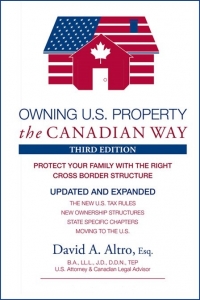
Owning U.S Property the Canadian Way, Third Edition

For decades, Canadians have been seeking refuge from the harsh Canadian winters by heading south to the sunny skies and sandy beaches of Florida, Arizona, California and the other Sun Belt states. Buying and owning U.S. property for a Canadian resident can be confusing, stressful and filled with uncertainty.

Americans Living in Canada – Smile, The IRS is Watching You

There are well over a million US citizens residing in Canada. Additionally, there are many Canadian citizens who were born in the US, or who have lived and worked there and later returned to Canada. Over the last few years the US government has stepped up its pursuit of Americans residing abroad who are not tax compliant.

About Us

Led by Managing Partner David A. Altro, Florida Attorney, Canadian Legal Advisor, Foreign Legal Counsel and Quebec Notary, author of the industry leading books OWNING US PROPERTY THE CANADIAN WAY, 3rd Edition, and also AMERICANS LIVING IN CANADA: SMILE, THE IRS IS WATCHING YOU, our team is ideally positioned to serve clients’ needs with offices in Canada’s largest metropolitan cities of Montreal, Toronto, Calgary and Vancouver and throughout the US Sunbelt states of Florida, Arizona, and California. 

Our team of US and Canadian-licensed attorneys have the unique ability to create tax and estate plans and then implement legal structures in accordance with the laws of relevant jurisdictions on both sides of the border. Altro LLP is celebrating over 35 years of consistent high level of legal expertise, knowledge, service and professionalism to clients around the globe.

About Us

Our Expertise

CANADIANS WITH US REAL ESTATE

Many Canadians already own US real estate, and given the increasing strength of the US real estate market, many others are contemplating purchasing or selling US property.

read more
CANADIANS MOVING TO THE US

Whether it is a snowbird wanting to spend more time in the US, someone hoping to move closer to family, or a career opportunity that takes one abroad; more and more Canadians are…

read more
EXPATRIATION
EXPATRIATION

we are dedicated to providing you with exceptional legal services tailored to your needs. We take pride in our current areas of expertise and are excited to share our plans for…

read more
CANADIANS WITH US REAL ESTATE

Many Canadians already own US real estate, and given the increasing strength of the US real estate market, many others are contemplating purchasing or selling US property.

read more
CANADIANS MOVING TO THE US

Whether it is a snowbird wanting to spend more time in the US, someone hoping to move closer to family, or a career opportunity that takes one abroad; more and more Canadians are…

read more
CANADIANS WITH US REAL ESTATE

Many Canadians already own US real estate, and given the increasing strength of the US real estate market, many others are contemplating purchasing or selling US property.

read more
CANADIANS MOVING TO THE US

Whether it is a snowbird wanting to spend more time in the US, someone hoping to move closer to family, or a career opportunity that takes one abroad; more and more Canadians are…

read more
EXPATRIATION
EXPATRIATION

we are dedicated to providing you with exceptional legal services tailored to your needs. We take pride in our current areas of expertise and are excited to share our plans for…

read more
SETTLEMENT OF ESTATES & PROBATE

Estate settlement refers to the administrative tasks required to wind up the affairs of a deceased person. Probate is the legal process through which a deceased person’s will is validated.

read more

Meet Your Legal Team

Our Team

David A. Altro

David A. Altro

B.A., LL.L., J.D., D.D.N., FLC, TEP, CLA

Managing Partner, Florida Attorney, Canadian Legal Advisor & Quebec Notary


Bradley R. Thompson

Bradley R. Thompson

B.A. (Hons), M.A., B.C.L., LL.B, LL.M (US Tax), FLC, CLA, TEP

Partner, New York, Québec and Ontario Attorney

Avi Guttman

Avi Guttman

B.A., J.D., FLC, CLA

Partner, Ontario, New Jersey, & New York Attorney

Jeffrey Feinberg

Jeffrey Feinberg

B.A., J.D.

Of Counsel, Florida Attorney

Matthew Silver

Matthew Silver

J.D., L.L.M, FLC, CLA

Of Counsel, Ontario & Florida Attorney


Eric Miller

Eric Miller

B.A., J.D.

Associate, Ontario Attorney

Stephania Fahmi

Stephania Fahmi

B.Sc., LL.L.

Associate, Ontario Attorney

Alessandro Tortis

Alessandro Tortis

B.A., LL.B., D.D.N.

Of Counsel, Quebec Notary

Cross Border News

At ALTRO LLP we are experts in our field and are often interviewed on television and the radio or quoted in newspapers, journals and magazines. We also encourage our attorneys to continually improve their knowledge and grow professionally with the publication of articles written on the areas of the law practiced at our firm. Click the links below to see Managing Partner David A. Altro’s most recent articles in the Globe and Mail and in the Advisor’s Edge Journal, as well as David’s interview with Global National for their Money 123 segment, or view the Cross Border News section of our website for more news stories.

Commonly Asked Questions

Should I buy a U.S. property in my personal name if I am a Canadian citizen and Canadian resident?
While it is legally possible for a Canadian citizen and resident to purchase U.S. property in their personal name, this approach is often not recommended for tax and estate planning reasons. Owning U.S. real estate personally can expose you to several potential issues, including U.S. estate tax exposure, probate complications, and personal liability. For these reasons, many Canadians purchase U.S. property through a cross-border ownership structure, such as a Canadian corporation, trust or limited partnership (LP). There are a number of issues that factor into the proper ownership structure, including, but not limited to, net worth, marital status, age, citizenship status (i.e. a US citizen living in Canada), use of the property (i.e. personal use, rental, or part-time rental), value of the property, whether it is an all-cash purchase or there will be financing, and more. Even within the different ownership structures, there are various permutations depending on all of the factors above. If implementing a partnership structure, should it be a Canadian partnership, a US partnership, or potentially a US partnership owned by a Canadian partnership? Should the general partner be an individual or an entity? If an entity, should it be a US entity or a Canadian entity? Similarly with trust ownership, should the trust be an irrevocable trust or a revocable trust? Who should be the settlor, trustees, beneficiaries? What are the specific trustee powers needed in the trust? What are the beneficiaries’ rights? It is clear that even within one structure, there a multitude of issues to consider, which are specifically nuanced as we deal with tax and estate issues on both sides of the border. For these reasons, it is best to consult with a cross-border tax and legal advisor to ensure the ownership structure minimizes tax exposure, simplifies estate administration, and protects against liability.
Is owning U.S. property in a trust advisable for a Canadian resident?
Owning U.S. property through a trust can offer advantages for estate planning and probate avoidance, but it must be structured very carefully when the owner is a Canadian resident. Probate, broadly speaking, is the process through which personally owned property (i.e. not owned through a trust) gets transferred to the decedent’s heirs. It is a time consuming and expensive process, involving long delays in transferring the property to the heirs and further legal and court fees to carry out the probate process. Additionally, probate documents are all pubic documents, so anyone can see a copy of the probate filings, including the decedent’s last will and testament; probate offers no privacy. A properly drafted Canadian resident trust, or in some cases a cross-border trust, can be effective to avoid U.S. probate, ensure privacy, and provide continuity of ownership. However, a standard U.S. revocable trust is usually not suitable for a Canadian, as it may trigger Canadian capital gains tax on transfer and create complex reporting obligations. We at Altro LLP have encountered numerous occasions of Canadians being advised by US lawyers and US real estate brokers that they should take title in a revocable trust to avoid probate. While this is a fairly common and standard practice in the US, these advisors do not have an understanding of how these “standard” US practices interplay with Canadian trust and tax law. There are many considerations that go into not only whether a trust is appropriate, but how exactly the trust should be structured to achieve optimal tax and estate planning efficiency in the cross-border context. Trust ownership is often advisable, but only if designed correctly with both U.S. and Canadian tax rules in mind, under guidance from a qualified cross-border tax and estate planning professional.
My father owns a condo in Fort Lauderdale, Florida and is a resident of Montreal, Canada. Unfortunately, he can no longer go there as he now has Alzheimer’s and we need to sell the condo. Can he still sign the seller documents?
Whether your father can sign the sale documents depends entirely on whether he is still legally competent to understand the nature and consequences of the transaction. If he is no longer competent, he cannot sign, and the sale must be handled through a valid Power of
Attorney (executed while he was competent) or by a court-appointed legal representative. The Power of Attorney must be reviewed by the Florida title company to ensure it meets state requirements and is properly authenticated. If no valid Power of Attorney exists, you may
need to establish a tutorship/curatorship in Quebec and have the representative’s authority recognized in Florida. The process to have the representative’s authority recognized in Florida is through a guardianship petition in the county courthouse where the property lies. This petition can be onerous, expensive and time consuming, requiring Florida counsel to petition the court on your behalf. It also risks delaying the property sale, as the sale cannot close until the court has formally appointed the guardian, which can take several months. A Guardianship proceeding will also require notifying certain family members about the application, often requiring their signed consent or otherwise providing them with formal legal notice. If certain family members wish to interject, or disagree on who should act as guardian, this can further complicate and delay the process. For this reason, it is important that owners of US real estate sign a properly drafted Florida power of attorney while competent to do so. Owners should not rely on Canadian protection mandates or powers of attorney, as they likely do not meet the strict requirements of a Florida power of attorney, and would require a court petition nonetheless.
I have three rental properties in the U.S. but I reside in Toronto. I am worried about what happens if a tenant has a slip and fall in one of the properties and is severely injured or dies from the accident. Do I have liability if the property is in my name personally?
Yes. If your U.S. rental properties are owned personally in your name, you can be held personally liable for any injury, accident, or death that occurs on the property. A successful lawsuit could expose all of your personal assets, including those in Canada, to collection. To protect yourself, you should maintain strong liability insurance (typically $1–2 million or more) and consider holding the properties through a limited liability entity, such as a properly structured corporation, limited partnership or limited liability company designed to work efficiently for both U.S. and Canadian tax purposes. Setting up the right ownership structure does not in and of itself guarantee liability protection for your other assets. It is important that depending on the structure, the appropriate corporate governance be maintained in order that a potential plaintiff cannot “pierce the corporate veil” and have it treated for liability purposes as personal ownership. Ownership through a trust can also provide liability protection in certain circumstances, depending on the nature of the trust. Many wrongfully assume that trust ownership automatically acts as a liability blocker, but that is often not the case. Trusts can be structured for various tax, liability, and estate planning purposes, with certain trusts providing more levels of liability protection than others. When owning multiple rental properties in the US, consideration must also be given to whether each property should be owned in a different manner. Holding each property in one entity can risk all the properties in the event of a slip and fall in one. Owning each property in a separate entity mitigates this risk, but comes with more expensive and burdensome annual compliance. It is also important to consider whether you will be financing any of the properties, as lenders may not approve of certain ownership structures.
If I sell my U.S. property for a profit as a Canadian citizen and resident of Canada, do I have to pay capital gains tax to the IRS? Do I have to pay capital gains tax to the CRA?
Yes. As a Canadian resident selling U.S. real estate for a gain, you are generally subject to capital gains tax in both the United States and Canada. However, the Canada–U.S. Tax Treaty ensures you are not taxed twice on the same income. Under a US law known as the Foreign Investment in Real Property Tax Act (“FIRPTA”), a non-resident/non-citizen of the US who sells US real estate is subject to a 15% withholding on the gross sale price, which is remitted to the IRS at the time of closing. Importantly, this withholding is not the seller’s actual tax liability. In the year following the sale, the seller will file a US tax return (form 1040NR) to calculate the actual capital gains tax on the sale, with top US tax rates on a long-term capital gain being 20% of the actual gain. If the actual tax is less than the 15% withholding, the seller will request a refund of the overpayment from the IRS. The same gain must also be reported in Canada, where 50% of the gain is included as ordinary income. However, Canada will allow a dollar for dollar tax credit for US taxes paid, thereby preventing double taxation. In short, both the IRS and CRA will tax the gain, but the treaty coordinates the taxes so that you only pay the higher of the two countries’ rates. Under certain circumstances, the FIRPTA withholding can be reduced from 15% to 10%, or sometimes eliminated completely, depending on the sale price and the buyer’s intended use of the property. There is an additional mechanism to reduce the withholding, depending on the facts, by applying for a “withholding certificate” from the IRS prior to closing. The rates and applicability of the FIRPTA withholding also depends on the nature of the ownership, such as whether its owned personally, through a trust, an entity, or joint ownership with a US citizen. It is therefore important to consult with qualified cross-border counsel both when purchasing US property and when selling US property.

Request a Consultation

Kindly complete the following form and we will promptly respond to your inquiry.


    :
    :
    :
    :
    :
    :
    :
    :
    Thank you for submitting your consultation request.
    A member of our team will be in touch with you as soon as possible.